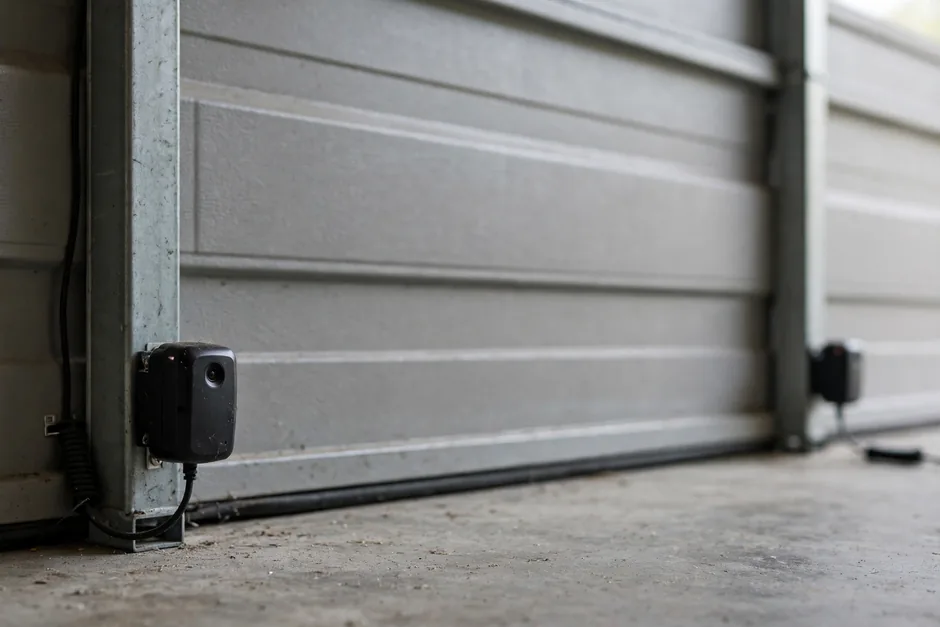
What safety sensors do
Safety sensors, also called photo-eyes, sit low on either side of the garage door, near the floor. One sends an invisible beam across the opening and the other receives it. If anything breaks that beam while the door is closing, the door should stop and reverse. That is the whole job of the sensors, and it is why a door that reverses for no clear reason, or will not close at all, often has a sensor fault rather than an opener fault. Sensors are a safety feature, not a convenience, so a door with faulty sensors should not be used until it is fixed. Call Springfield Garage Door Rescue at (615) 235-0324 if the door will not close and you cannot find a clear sensor cause.
Safe tests, step by step
- Look at both sensors. With the door open, look at each sensor unit near the floor. Check for dirt, cobwebs, damage or anything stored against them, and clear the area around them.
- Clean the lenses. Wipe both lenses with a soft, dry cloth. Dust, cobwebs and condensation cloud the beam and cause false reversals.
- Check alignment. Both sensors should point directly at each other across the opening. If one looks knocked sideways, gently straighten it by hand if it moves freely, and check whether the lights steady. Do not force a sensor that will not move, and do not touch springs or cables while doing this.
- Check the lights. Most sensors have small lights that show whether they are powered and aligned. Steady lights usually mean the beam is clear, while blinking or dark lights point to a fault. The exact meaning varies by brand, so check your opener manual for your model.
- Test the reversal, following your manual. With the door closing and everyone clear, follow your opener manual method for testing reversal. The door should stop and reverse when the beam is broken. If it does not reverse, stop using the door and call a pro. Do not put a hand, foot or body part in the path of a closing door to test it.
What the lights usually mean
In general terms, steady sensor lights usually mean power and alignment are good, while a blinking light often means misalignment or a blocked beam, and a dark light often means no power or a wiring fault. Those are general patterns only, since brands differ, and your opener manual is the reliable guide for your model. If cleaning and alignment do not steady the lights, the fault may be wiring, a damaged sensor or an opener board problem, and those need a pro. For sensor faults beyond cleaning and alignment, see sensor repair.
When cleaning and alignment do not fix it
Call a pro if the lights stay blinking or dark after cleaning and alignment, if a sensor is cracked or its bracket is bent, if wiring looks damaged, or if the door still does not reverse when the beam is broken. Do not bypass, tape over or disconnect sensors to make the door close, since that removes a safety feature and can leave the door dangerous. Homes in Adams often call about reversing doors, and sensor cleaning fixes many of them, but a sensor that stays faulty after cleaning needs a proper check. If the door also grinds or sticks, see roller replacement.
Call a pro for anything beyond testing
Testing, cleaning and alignment checks are homeowner jobs. Anything beyond that, including wiring, sensor replacement, opener board work and anything involving springs or cables, belongs to a pro. If you are unsure whether a fault is a sensor fault or something else, call and describe the lights and what the door does. Regular hours are Mon-Fri 7AM-7PM and Sat 8AM-4PM, with emergency service available around the clock for a door that will not secure.
Frequently Asked Questions
1. Why does my Springfield door reverse when nothing is in the way?
Dirty or misaligned photo-eye sensors are the most common cause, followed by a rough spot in the track. Cleaning the lenses and checking alignment fixes many reversing doors.
2. How do I know if my garage door sensors are aligned?
Both sensors should point directly at each other across the opening, and their lights should be steady. Blinking lights often mean misalignment, though the exact meaning varies by brand, so check your opener manual.
3. Can I clean garage door sensors myself?
Yes. Wiping both lenses with a soft, dry cloth and clearing anything blocking the beam are safe homeowner checks. Do not touch springs or cables while doing this.
4. What should I do if my door does not reverse when the beam is broken?
Stop using the door and call a pro. A door that does not reverse has lost a safety feature, and it should not be used until it is fixed. Do not bypass or disconnect the sensors.
5. Do safety sensors work in the dark?
Yes, the beam is invisible and works in the dark. If a door reverses at night, check for dirt, condensation or an object blocking the beam, and call if cleaning does not fix it.
Get help with your garage door in Springfield
If you would rather not guess, call Springfield Garage Door Rescue at (615) 235-0324. Tell us what the door is doing and we will talk through the next step and give you a price before work starts.